

Definitions
Diversity
Physical, social, and psychological differences between people and groups, including things such as race, ethnicity, gender, ability, sexual orientation, gender identity, national origin, tribe, socio-economic status, thinking, and communication styles.
Equity
The policy or practice of accounting for the differences in each individual's starting point when pursuing a goal or achievement, and working to remove barriers to equal opportunity, as by providing support based on the unique needs of individuals.
Inclusion
The practice or policy of including and intregrating all people and groups in activities, organizations, and processes; inclusion puts diversity into meaningful action and builds a culture of belonging, respect, and connection by actively inviting the contribution and participation of all people.
Training
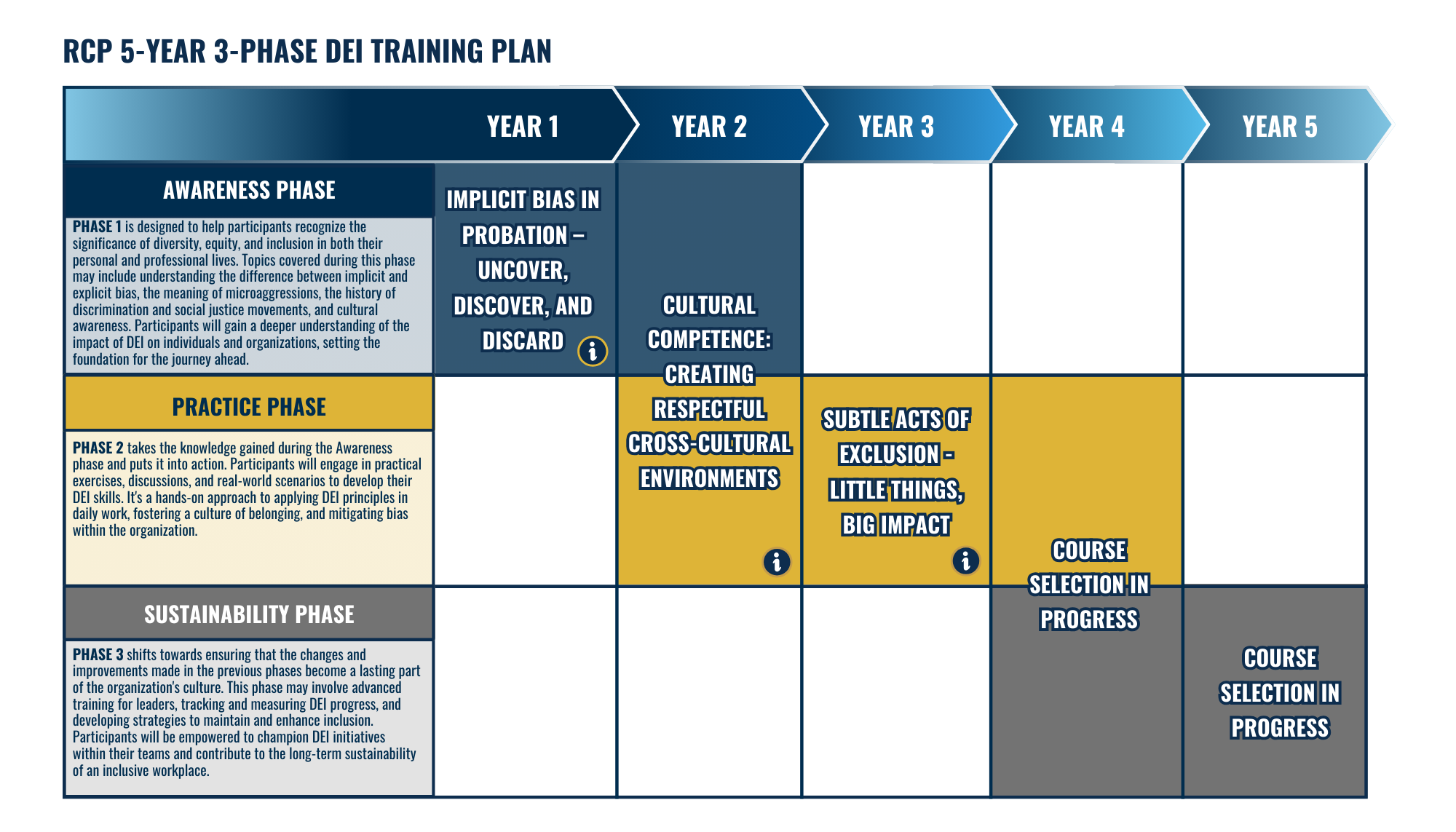
The first purpose of this course will be to help probation staff, supervisors
and management to become aware of their own unconscious and implicit biases
and how these biases impact the way they interact with each other as well as
with probation clients (and their family) and the wider community
(including interfacing with other agencies).
The second purpose will be to create strategies and practices within
the departmental daily culture that will reduce opportunity for ongoing
unconscious and implicit biases.
The third purpose of this course will be to actively eliminate workplace
biases and officer to offender biases. The instructor will facilitate
targeted interventions and exercises aimed at altering perception,
attitudes and actions of participants. The content of the course will be
designed to transfer back to the workplace through concrete instructions
of actions to take for each situation.
.
Given our current social, political environment, cultural competence is critical
to achieving success in the law enforcement setting. Cultural Competence is
defined as a set of congruent behaviors, attitudes and policies that come together
as a system, agency or among professionals and enable that system, agency or
those professionals to work effectively in cross-cultural situations.
The unobservable psychological impact of implicit/explicit bias on coworkers,
the public, defendants, community-based organizations, subordinates, inmates,
etc. can go largely unnoticed until the threat of a class action suit or a case
of excessive use of force brings them to light.
Interpersonal competence in cross-cultural situations is the key to creating
environments that are safe so that law enforcement can fulfill our mission of
protection and service. Understanding the components of cultural competence
leads to improved decisions/behaviors while working with probationers;
children and adults.
The course chosen for Year 2, titled 'Cultural Competence: Creating Respectful Cross-Cultural Environments,' has received overwhelmingly positive feedback from participating staff members, reflecting promising mid-year results. Explore the comments and experiences shared by them below.